
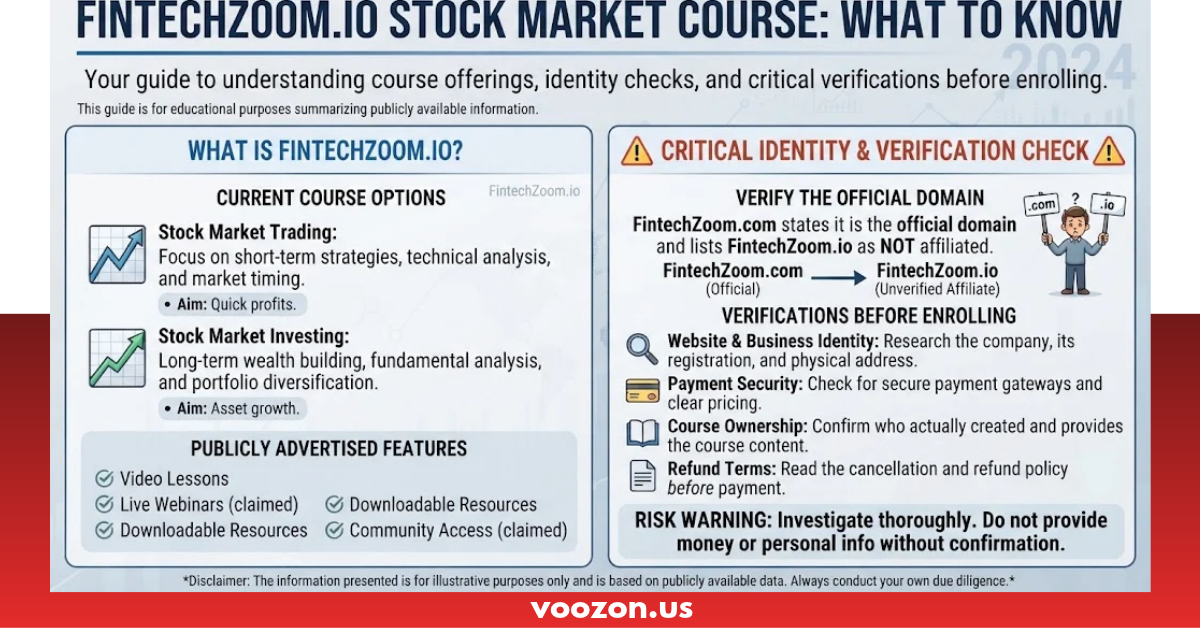
Searching for the fintechzoom.io stock market course can create confusion because the website currently presents more than one financial education option. Its public course pages list Stock Market Trading and Stock Market Investing programs, each aimed at different learning goals.
There is also an important identity check before enrollment. FintechZoom.com says that fintechzoom.com is its official domain and specifically lists fintechzoom.io among domains it says are not affiliated with FintechZoom. Because of that conflict, readers should verify the website, business identity, payment details, course ownership, and refund terms before providing money or personal information.
This guide explains what the .io website currently publishes, what students can expect from the advertised courses, and which questions deserve answers before purchase.
Quick Answer: What Does the FintechZoom.io Stock Market Course Offer?
The fintechzoom.io stock market course is not presented as one single program. The site’s course catalog includes a Stock Market Trading Mastery Course and a FintechZoom Investment Mastery Course.
The trading course focuses on subjects such as:
- Stock-market basics
- Candlestick patterns
- Market trends
- Day trading
- Swing trading
- Position trading
- Stop-loss strategies
- Trading psychology
- Market indicators
- Trading platforms and software
- Options and forex basics
- Algorithmic trading
- Capital and risk management
The investing course takes a longer-term approach. It covers asset classes, diversification, portfolio construction, value investing, dividend strategies, index investing, risk management, economic indicators, and other investment concepts.
However, the presence of these course pages does not independently establish that the .io website is an authorized FintechZoom.com product. That is the most important distinction to understand before enrolling.
What Does the FintechZoom.io Trading Course Teach?
The Stock Market Trading page describes a course designed for new traders, intermediate traders, and working professionals. Its listed curriculum moves from basic market concepts toward chart analysis, trading styles, risk controls, psychology, and more advanced subjects.
The advertised topics include:
| Topic | What the course page says it covers |
| Market basics | Understanding markets and how trading works |
| Candlesticks | Reading common candlestick patterns |
| Trends | Identifying price trends and movements |
| Trading styles | Day, swing, and position trading |
| Risk management | Stop-loss methods and capital protection |
| Psychology | Emotional discipline and trading behavior |
| Indicators | Understanding important market indicators |
| Technology | Trading apps, software, and automation |
| Advanced markets | Stocks, options, and forex |
| Algorithmic trading | Introduction to automated trading |
| Market news | How global events can influence markets |
The website also states that the trading program includes 4–6 hours of on-demand video lessons, practical resources, quizzes, and a certificate of completion.
These are descriptions published by the .io website itself, so they should be treated as the site’s advertised features, rather than independently verified outcomes.
How Is the Investing Course Different?
The investing program is aimed more at people who want to understand portfolio building and long-term investing.
According to its public course page, the program discusses:
- Stocks and equities
- Bonds
- Mutual funds
- ETFs
- Real estate
- Alternative investments
- Asset allocation
- Diversification
- Value investing
- Dividend growth investing
- Passive index strategies
- Rebalancing
- Hedging
- Economic indicators
- International markets
- Investment psychology
- Options and futures
- Artificial intelligence and robo-advisors
The site says the investment course contains 7–8 hours of on-demand lessons, printable worksheets, interactive quizzes, and certification.
This creates a useful distinction: someone interested in active trading may look at the trading curriculum, while someone focused on building and managing a portfolio may find the investing curriculum more relevant.
FintechZoom.io Stock Market Course: Trading vs. Investing
The two advertised tracks serve different purposes.
| Feature | Trading Course | Investing Course |
| Main goal | Active market participation | Long-term investment planning |
| Best starting point | New or intermediate traders | New or intermediate investors |
| Technical analysis | Strong focus | Included as part of analysis |
| Candlestick patterns | Yes | Less central |
| Day trading | Yes | Not the main focus |
| Swing trading | Yes | Not the main focus |
| Portfolio allocation | Included | Major topic |
| Diversification | Included | Major topic |
| Trading psychology | Yes | Investment behavior |
| ETFs | Discussed | Discussed |
| Options/futures | Introduced | Introduced |
| Video length advertised | 4–6 hours | 7–8 hours |
| Quizzes | Yes | Yes |
| Certificate | Yes | Yes |
The choice between the two should depend on the skill you actually want to develop, not simply the course name.
What Does the Website Say About Course Access?
The public course pages describe the programs as self-paced learning experiences. That means students can work through the material according to their own schedule instead of attending a traditional classroom course.
The trading page advertises video lessons, practical resources, quizzes, and certification. The investing page adds printable worksheets and describes a broader set of portfolio and financial-planning topics.
Before paying, however, confirm the exact access conditions. Check whether the advertised access period, updates, support, certificate, and other benefits are clearly stated at checkout.
Is FintechZoom.io the Same as FintechZoom.com?
No. This is the most important point to verify.
FintechZoom.com has published a page identifying itself as the official FintechZoom domain. That page specifically lists fintechzoom.io among websites it says are not affiliated with FintechZoom.
At the same time, fintechzoom.io has its own publicly accessible course pages using the FintechZoom name and describing trading and investing programs.
These two facts create a domain-identity issue that prospective students should not ignore.
What should you do?
Before purchasing:
- Check the exact domain in your browser.
- Confirm who operates the website.
- Look for a clear legal business name.
- Review the refund policy.
- Check the payment recipient.
- Verify the instructor information.
- Ask whether the course is officially connected to FintechZoom.com.
- Avoid sending sensitive financial information until the identity is clear.
This is a simple but important due-diligence step.
Is the FintechZoom.io Stock Market Course Legit?
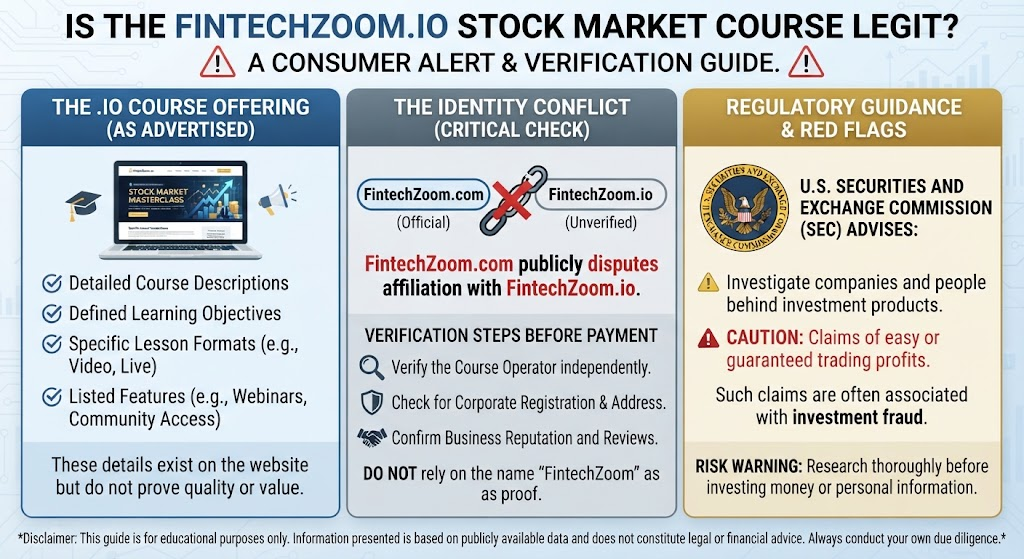
A course page alone cannot prove the quality, authorization, or financial value of an education product.
The .io website does provide detailed course descriptions, learning objectives, lesson formats, and advertised features.
But FintechZoom.com publicly disputes the affiliation, stating that fintechzoom.io is not connected to its official domain.
Therefore, a careful buyer should avoid treating the name “FintechZoom” as proof of authorization. Verify the operator independently before paying.
The U.S. Securities and Exchange Commission also advises investors to investigate companies and people behind investment-related products and to be cautious about claims involving easy or guaranteed trading profits.
Does the Course Guarantee Stock Market Profits?
No course should be treated as a guarantee of trading profits.
The advertised course material can teach concepts such as chart reading, trading styles, risk management, portfolio construction, and market analysis. Those skills can improve financial knowledge, but learning a strategy does not guarantee that the strategy will produce profits.
Investor.gov states that every investment involves some degree of risk. It also advises investors to understand why they are buying or selling and to understand the risks before trading.
For day trading, FINRA highlights additional risks and says day trading can be extremely risky, particularly for people with limited resources or experience.
A good course should therefore be viewed as education—not as a shortcut to guaranteed returns.
What Are the Strongest Learning Areas?
Based strictly on the subjects listed on the public course pages, several areas stand out.
1. Market Fundamentals
Beginners need to understand what stocks are, how markets work, and how orders and price movements fit together.
2. Technical Analysis
The trading curriculum includes candlestick patterns, trends, price movement, and market indicators.
3. Risk Management
Stop-loss strategies, capital protection, portfolio allocation, and emotional discipline are included in the advertised trading curriculum.
4. Trading Psychology
The course specifically includes emotional discipline and trading psychology, which are important parts of developing a consistent process.
5. Portfolio Building
The investing program discusses asset allocation, diversification, rebalancing, and long-term investment strategies.
These areas provide a broader learning path than a course focused only on chart patterns.
What Should You Verify Before Buying?
A smart purchase starts with questions.
| Question | Why It Matters |
| Who owns the website? | Confirms the actual business behind the product |
| Is it affiliated with FintechZoom.com? | The official .com site disputes that affiliation |
| Who teaches the course? | Helps assess instructor credentials |
| What is the current price? | Prevents unexpected costs |
| Is payment one-time or recurring? | Important for budgeting |
| What is the refund policy? | Protects you if the course is unsuitable |
| How long is access available? | Determines the real value of the purchase |
| Are updates included? | Markets and platforms change |
| Is there a sample lesson? | Lets you judge teaching quality |
| What does the certificate represent? | A completion certificate is not automatically professional accreditation |
| What support is provided? | Clarifies whether help is available after purchase |
The SEC recommends researching the people or company behind investment-related products and being cautious about high-pressure sales tactics and claims of easy profits.
How to Use a Stock Market Course Effectively
Buying a course is only the first step. The real value comes from applying what you learn carefully.
Start With the Basics
Learn terminology before placing trades. Understand stocks, ETFs, market orders, limit orders, diversification, volatility, and risk.
Practice Without Real Money
Use paper trading or a simulated account while learning. This lets you test whether you understand an idea before putting capital at risk.
Build a Written Trading Plan
If you study trading, write down:
- Entry conditions
- Exit conditions
- Maximum acceptable loss
- Position size
- Trading timeframe
- Reason for entering
- Reason for exiting
Track Every Trade
Keep a journal showing what happened and why. Over time, this can reveal repeated mistakes and help you improve your process.
Avoid Emotional Decisions
Do not increase a position simply because a trade is losing. Do not chase a stock because it is trending on social media.
Investor.gov warns that online information can encourage impulsive decisions and recommends researching investments instead of acting from short-term excitement.
How Much Risk Should Beginners Take?
There is no universal position size that works for every investor.
Your risk depends on factors such as:
- Income
- Savings
- Financial obligations
- Investment timeframe
- Experience
- Risk tolerance
- Emergency savings
- Investment objective
FINRA specifically warns that day trading may not be appropriate for people with limited resources or limited trading experience. It also warns against funding day trading with money needed for living expenses, education, housing, or emergencies.
For beginners, learning risk management before aggressive trading is more important than finding a “winning” setup.
FintechZoom.io Stock Market Course: Who May Find It Useful?
The advertised curriculum may be relevant to someone who wants structured material covering several areas of trading or investing.
Potentially suitable for:
- Beginners learning stock-market terminology
- New traders studying technical analysis
- Investors learning portfolio concepts
- Working people who prefer self-paced lessons
- Students who want quizzes and structured learning
- Learners who want to study risk management and psychology
Consider more research if you need:
- Accredited academic credentials
- Licensed financial advice
- One-on-one investment management
- A verified professional trading record
- Personalized portfolio recommendations
- Guaranteed investment returns
A course certificate should not automatically be treated as a professional license, regulatory qualification, or proof of trading ability.
What Are the Alternatives to Paying for a Course?
A paid course is not the only way to learn.
Government and industry organizations provide free educational material. Investor.gov, for example, provides resources covering investing basics, risk, online investing, fraud prevention, and due diligence.
FINRA also provides educational material covering trading concepts and the risks associated with day trading.
A practical learning path can look like this:
- Learn market fundamentals.
- Study risk and diversification.
- Learn basic technical and fundamental analysis.
- Practice with simulated trades.
- Build a written plan.
- Track results.
- Start small only after understanding the risks.
This approach helps you judge whether a paid course adds enough value for your needs.
FintechZoom.io Stock Market Course: Pros and Things to Check
| Area | What the public pages show | What to verify |
| Course variety | Trading and investing tracks | Exact current offerings |
| Learning format | On-demand/self-paced material | Actual access terms |
| Trading content | Technical analysis and trading styles | Depth of each module |
| Investing content | Portfolio and asset-allocation topics | Detailed syllabus |
| Practical material | Resources and worksheets | What files are actually included |
| Quizzes | Advertised | Number and format |
| Certification | Advertised | What the certificate means |
| Instructor claims | References to experts/professionals | Names and credentials |
| Website identity | .io course pages exist | Relationship with FintechZoom.com |
| Pricing | Should be checked before purchase | Total and recurring charges |
| Refunds | Should be reviewed before payment | Exact refund conditions |
The key issue is not simply whether course topics exist. It is whether the person buying the course understands exactly who is selling it, what they receive, and what the certificate or education does and does not represent.
A Simple Checklist Before Enrollment
Save this checklist before making a payment:
- I confirmed the exact domain.
- I know who operates the website.
- I checked whether it is affiliated with FintechZoom.com.
- I found the current course price.
- I read the refund policy.
- I understand the payment terms.
- I reviewed the syllabus.
- I checked the instructor information.
- I understand what the certificate means.
- I know how long I get access.
- I understand that trading involves financial risk.
- I am not relying on the course as a promise of profit.
If several answers remain unclear, pause and investigate before paying.
Frequently Asked Questions
Is the FintechZoom.io stock market course one course?
No. The .io website currently presents separate Stock Market Trading and Stock Market Investing programs, alongside a financial-literacy course category.
Is fintechzoom.io affiliated with FintechZoom.com?
FintechZoom.com says it is the official FintechZoom domain and states that fintechzoom.io is not affiliated with it. The .io website, meanwhile, publishes its own courses under the FintechZoom name. Buyers should verify the relationship before purchasing.
How long is the trading course?
The fintechzoom.io Stock Market Trading page advertises 4–6 hours of on-demand video lessons.
How long is the investing course?
The Stock Market Investing page advertises 7–8 hours of on-demand lessons, plus worksheets and quizzes.
Does completing the course guarantee trading profits?
No. Education cannot guarantee investment returns. Stocks and other investments carry risk, and regulators warn investors to be skeptical of guaranteed-profit claims.
What should I check before paying?
Confirm the operator, domain relationship, instructor credentials, price, refund policy, access period, curriculum, payment terms, and meaning of the certificate. Most importantly, verify that you are dealing with the intended organization before sharing financial or personal information.
Conclusion:
The fintechzoom.io stock market course has a clearly presented educational structure on its public website, with separate paths for trading and investing and topics ranging from market basics to technical analysis, portfolio management, risk control, and trading psychology.
But there is a major verification point that should come before any purchase: FintechZoom.com says fintechzoom.io is not affiliated with its official domain. That claim means prospective students should not assume that the .io course carries the identity, authority, or backing of FintechZoom.com simply because the names are similar.