
Healthcare is one of the largest and most diverse sectors of the stock market. It includes pharmaceutical manufacturers, biotechnology companies, medical equipment producers, hospitals, and healthcare service providers. However, finding promising companies requires more than following market trends or choosing stocks with attractive ratings. 5starsstocks.com healthcare gives readers a starting point for exploring this sector, understanding different healthcare businesses, and discovering potential investment opportunities. This guide explains its coverage, important features, investment considerations, and risks to help readers make better-informed decisions.
What Is 5StarsStocks.com Healthcare?
5starsstocks.com healthcare refers to the healthcare industry section of 5StarsStocks.com, a financial research and educational website that publishes stock-related articles, sector information, investment ideas, and market insights.
The healthcare category focuses on businesses connected to medical treatments, pharmaceutical products, biotechnology, healthcare equipment, and patient services. It gives readers an introduction to the companies and industry segments that contribute to the wider healthcare economy.
Rather than treating every healthcare company as the same type of investment, readers can explore businesses according to their products, services, financial performance, and market position.
The website also publishes educational information about healthcare stocks, including factors that can affect company performance and potential investment risks.
Quick Answer: 5starsstocks.com healthcare is a sector-based research resource for people interested in healthcare-related stocks. It helps readers explore the industry, but its information should be independently verified before making investment decisions.
How Does 5StarsStocks.com Healthcare Work?
The healthcare section introduces readers to different areas of the medical and pharmaceutical industries. Its educational approach helps investors understand how individual companies operate and what financial factors may influence their performance.
The platform’s healthcare article, Investing in Healthcare Stocks: A Beginner’s Guide, discusses pharmaceutical companies, biotechnology businesses, medical device manufacturers, healthcare providers, and healthcare real estate investment trusts.
Readers can use this information to build a basic understanding of the sector before researching individual companies.
A practical research process involves:
- Exploring the healthcare category to understand its coverage.
- Identifying companies operating in different healthcare subsectors.
- Reviewing their products, services, and business models.
- Checking company financial statements and earnings reports.
- Investigating regulatory developments and industry competition.
- Comparing investment risks before considering a purchase.
It is important to distinguish between educational content and verified financial research. The website describes its research approach, but investors should independently check company figures, research methods, and investment claims.
Main Healthcare Investment Categories
Healthcare includes several business models. Each category has different sources of revenue, growth opportunities, and financial risks.
Understanding these differences helps investors avoid comparing companies that operate in completely different parts of the industry.
Pharmaceutical Companies
Pharmaceutical companies research, develop, manufacture, and sell medicines. Their products may treat chronic conditions, infections, cancer, cardiovascular diseases, and other medical problems.
Some established companies in this category include:
- Johnson & Johnson (JNJ)
- Pfizer (PFE)
- Merck & Co. (MRK)
- AbbVie (ABBV)
- Bristol Myers Squibb (BMY)
Investors should examine drug sales, research spending, patent protection, product competition, and regulatory approvals.
A medicine approaching the end of its patent protection may face competition from generic alternatives. This can affect revenue and future earnings.
Biotechnology Companies
Biotechnology companies use biological research and advanced technologies to develop treatments, medicines, and diagnostic products.
Examples include Amgen (AMGN), Gilead Sciences (GILD), and Regeneron Pharmaceuticals (REGN).
Biotechnology investments can offer significant growth potential when companies develop successful treatments. However, clinical trial failures, research delays, funding requirements, and regulatory decisions can create substantial uncertainty.
Medical Device Companies
Medical device manufacturers produce equipment and technology used to diagnose, monitor, and treat medical conditions.
Their products include surgical instruments, diagnostic systems, implants, imaging equipment, and patient-monitoring devices.
Examples include:
- Medtronic (MDT)
- Abbott Laboratories (ABT)
- Boston Scientific (BSX)
- Intuitive Surgical (ISRG)
- Stryker (SYK)
Investors should examine product demand, hospital purchasing budgets, innovation, manufacturing costs, and competition.
Healthcare Providers and Services
This category includes companies that deliver healthcare services directly to patients or support the delivery of medical care.
Examples include hospitals, laboratories, healthcare networks, insurance-related services, and dialysis providers.
Companies such as HCA Healthcare (HCA), CVS Health (CVS), and DaVita (DVA) operate in different parts of this industry.
Their financial performance can depend on patient numbers, operating expenses, reimbursement rates, insurance arrangements, and healthcare policies.
Healthcare Real Estate Investment Trusts
Healthcare REITs invest in properties used for medical and healthcare services.
These properties may include hospitals, senior living facilities, nursing homes, and medical office buildings.
Examples include:
- Welltower (WELL)
- Ventas (VTR)
- Healthcare Realty Trust (HR)
Investors should review rental income, occupancy levels, debt, interest expenses, tenant quality, and property valuations.
Complete Comparison Table of Healthcare Stock Categories
The following table compares the major healthcare investment categories covered by the sector and explains what investors should examine before researching individual companies.
| Healthcare category | Main business activity | Company examples | Important research factors | Main risks |
| Pharmaceuticals | Develop and sell medicines | Pfizer, Merck, AbbVie | Drug sales, patents, research pipeline | Patent expiry, competition |
| Biotechnology | Develop biological treatments | Amgen, Gilead, Regeneron | Clinical trials, funding, product pipeline | Trial failure, regulatory delays |
| Medical devices | Manufacture medical equipment | Abbott, Medtronic, Stryker | Product demand, innovation, margins | Product recalls, competition |
| Healthcare providers | Deliver medical services | HCA Healthcare, CVS, DaVita | Patient volume, costs, reimbursement | Policy changes, operating costs |
| Healthcare REITs | Own healthcare-related properties | Welltower, Ventas | Occupancy, rental income, debt | Interest rates, tenant problems |
| Medical diagnostics | Provide testing and diagnostic products | Quest Diagnostics, Labcorp | Testing volumes, pricing, technology | Pricing pressure, regulation |
| Healthcare technology | Develop digital medical solutions | Veeva Systems, Doximity | Revenue growth, customer retention | Competition, technology changes |
Important: These examples are for educational research. Their inclusion does not mean they are current recommendations or guaranteed investment opportunities.
Why Are Healthcare Stocks Important to Investors?
Healthcare plays an essential role in everyday life. People need medicines, diagnostic services, medical equipment, hospitals, and long-term treatment regardless of short-term changes in consumer preferences.
This creates several reasons why investors examine the healthcare sector.
Consistent Demand for Medical Services
Medical services address ongoing health needs. Hospitals, laboratories, pharmaceutical companies, and medical equipment providers support essential activities across healthcare systems.
However, consistent demand for medical services does not guarantee consistent profits or stable stock prices.
Medical Research and Innovation
Scientific research can create new treatments, diagnostic methods, and medical technologies.
Companies that successfully introduce valuable products may expand their customer base and increase revenue. Investors should still examine the cost of developing these products and the time required to bring them to market.
Long-Term Industry Development
Population changes, chronic disease management, healthcare access, and medical technology can influence industry demand over many years.
For example, the US Centers for Medicare & Medicaid Services reported that national healthcare expenditure reached $5.3 trillion in 2024, representing 18% of US gross domestic product.
This figure demonstrates the economic scale of the healthcare industry, although industry spending does not automatically translate into shareholder returns.
Different Investment Opportunities
Healthcare offers several types of businesses, from established pharmaceutical manufacturers to smaller biotechnology developers.
This variety allows investors to compare companies with different growth strategies, financial positions, and risk levels.
Important Features of 5StarsStocks.com Healthcare
The value of a sector research website depends on how effectively its information helps readers understand the market.
The healthcare content on 5StarsStocks.com provides several useful areas for exploration.
Sector-Based Information
Readers can explore healthcare companies according to their business activities rather than looking at the entire stock market as one category.
This makes it easier to understand differences between pharmaceutical manufacturers, medical technology companies, and healthcare providers.
Beginner-Friendly Educational Content
The website publishes introductory material about healthcare stocks and investment considerations.
Readers who are unfamiliar with pharmaceutical development or medical device businesses can use this information to understand basic industry concepts.
Company Research Starting Points
Healthcare articles can help readers identify companies for further investigation.
However, an article mentioning a company does not establish that its shares are undervalued or suitable for a particular investor.
Investment Risk Awareness
The website’s healthcare coverage discusses regulatory issues, product development, competition, and other industry challenges.
These subjects are important because healthcare companies often depend on complex scientific, commercial, and regulatory processes.
Wider Market Coverage
The healthcare category sits within a broader website that also covers other stock market sectors and investment styles.
Readers can use the wider material to understand how healthcare businesses compare with companies in technology, energy, consumer goods, and other industries.
How to Evaluate Healthcare Stocks Before Investing
Exploring healthcare stocks is only the first step. Investors need to examine each company’s financial condition, business strategy, product performance, and competitive position.
Here are the most important factors to consider.
Revenue and Earnings Growth
Review a company’s revenue over several years. Consistent growth can indicate rising demand, successful products, or expansion into new markets.
Also examine net income and operating margins. Revenue growth alone does not guarantee profitability.
Research and Development Spending
Research and development (R&D) is especially important for pharmaceutical and biotechnology companies.
Compare R&D spending with revenue and examine whether the company has products progressing through clinical development.
Debt and Cash Flow
A company with high debt may face difficulties when interest rates rise or operating income falls.
Review its balance sheet, cash reserves, debt obligations, and operating cash flow to understand its financial position.
Product Pipeline
A pharmaceutical or biotechnology company’s product pipeline can influence its future growth.
Check the development stage of each major treatment, clinical trial results, expected regulatory decisions, and potential commercial competition.
Management and Corporate Governance
Experienced leadership and transparent financial reporting can help investors understand how a company manages its resources.
Review executive backgrounds, shareholder communications, corporate filings, and major business decisions.
Valuation
Even a financially strong healthcare company can become an expensive investment if its share price rises too far above its underlying business value.
Compare valuation measures such as:
- Price-to-earnings (P/E) ratio
- Price-to-sales (P/S) ratio
- Enterprise value to EBITDA (EV/EBITDA)
- Free cash flow yield
- Dividend yield, where applicable
Use these measures alongside business fundamentals rather than relying on one number.
Understanding FDA Approvals and Clinical Trials
Regulatory approval is one of the most important factors affecting pharmaceutical and biotechnology businesses.
In the United States, the Food and Drug Administration (FDA) reviews evidence about a medicine’s safety and effectiveness before approving it for its intended use.
The development process generally includes several stages:
- Discovery and development: Researchers identify potential treatments and study how they work.
- Preclinical research: Companies conduct laboratory and animal testing to evaluate safety.
- Clinical research: Researchers test treatments in human participants.
- FDA review: The agency evaluates submitted evidence and decides whether to approve the product.
- Post-market monitoring: Safety information continues to be monitored after a product reaches the market.
Each stage requires time, money, and scientific evidence.
A promising clinical trial does not guarantee regulatory approval. Similarly, FDA approval does not guarantee commercial success because pricing, competition, insurance coverage, and market demand also affect revenue.
Readers using 5starsstocks.com healthcare for investment research should verify important drug-development claims through official FDA announcements and company disclosures.
Risks Associated With Healthcare Sector Investing
Healthcare businesses can offer different growth opportunities, but they also face risks that investors must understand.
Regulatory Changes
Government agencies can change approval requirements, pricing rules, and industry regulations.
These developments may affect company expenses, product availability, and future earnings.
Clinical Trial Failures
A medicine may fail to demonstrate sufficient safety or effectiveness during clinical testing.
For smaller biotechnology companies, an unsuccessful trial can significantly affect business prospects and share prices.
Patent Expiration
Pharmaceutical companies may lose market exclusivity when patents expire.
Generic alternatives can enter the market, increasing competition and reducing sales of established medicines.
Product Recalls and Safety Concerns
Manufacturing problems, safety issues, or product recalls can damage a company’s reputation and increase financial costs.
High Research Expenses
Developing new treatments requires significant investment. Companies may spend years researching products without generating commercial revenue.
Market Volatility
Healthcare stocks can experience sharp price movements following earnings reports, regulatory decisions, clinical trial results, and industry announcements.
Risk management matters: Never assume that a company’s medical importance makes its shares a safe investment.
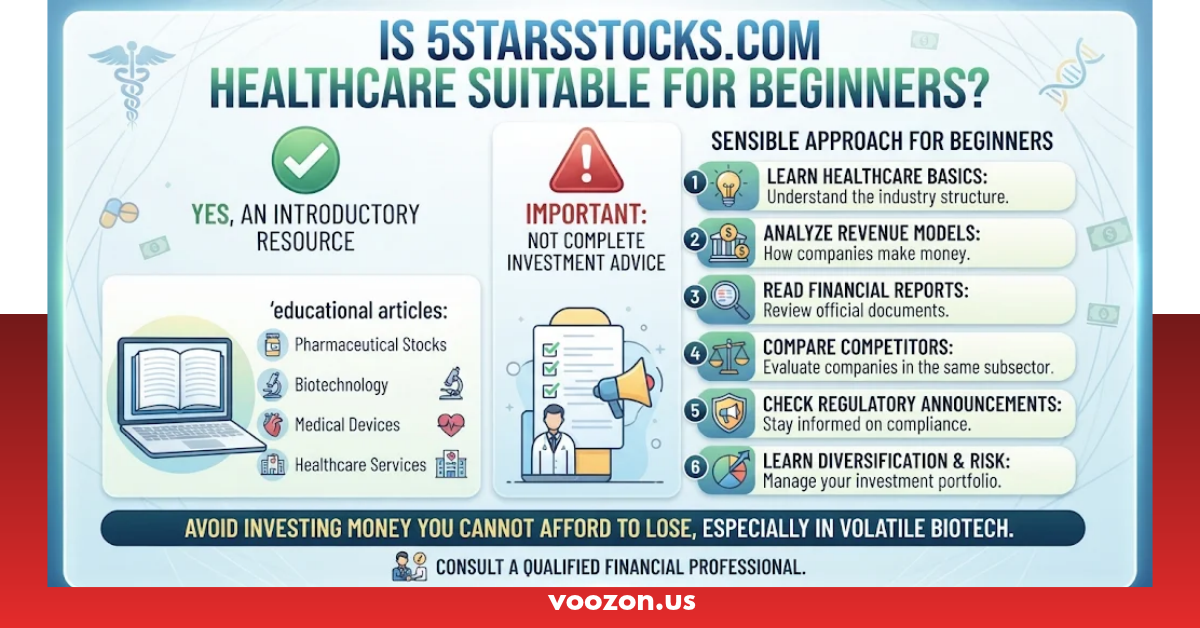
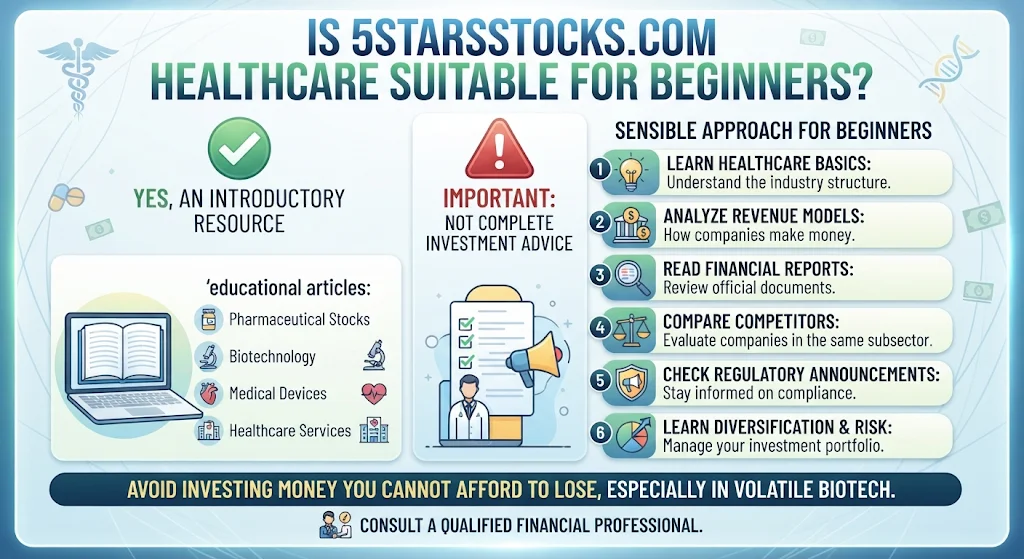
Is 5StarsStocks.com Healthcare Suitable for Beginners?
Yes, it can serve as an introductory research resource for people who want to understand healthcare companies and their different business models.
Its educational articles introduce topics such as pharmaceutical stocks, biotechnology, medical devices, and healthcare services.
However, beginners should not treat website articles or stock ratings as complete investment instructions.
A sensible approach includes:
- Learning the basics of the healthcare industry.
- Understanding how individual companies generate revenue.
- Reading official financial reports.
- Comparing competitors within the same subsector.
- Checking regulatory announcements.
- Learning about diversification and investment risk.
- Consulting a qualified financial professional when necessary.
Beginners should also avoid investing money they cannot afford to lose, particularly in smaller biotechnology businesses with uncertain research outcomes.
How to Use 5StarsStocks.com Healthcare for Better Research
A structured approach can make sector research more useful.
Follow these steps when exploring 5starsstocks.com healthcare:
Step 1: Visit the official website
Open 5StarsStocks.com and navigate to its Sectors & Industries section.
Step 2: Select Healthcare
Explore the healthcare category and read its educational material to understand the different industry segments.
Step 3: Identify companies
Make a list of businesses that interest you. Separate pharmaceutical manufacturers, biotechnology developers, medical device producers, and healthcare service providers.
Step 4: Check official company information
Visit company investor relations pages and review annual reports, quarterly earnings, financial statements, and business updates.
Step 5: Verify medical and regulatory information
Use FDA resources to check drug approvals and clinical development information. Do not rely entirely on a third-party summary of a regulatory announcement.
Step 6: Compare financial performance
Examine revenue, earnings, cash flow, debt, valuation, and competitive position.
Step 7: Assess investment risk
Consider your investment goals, holding period, financial position, and ability to tolerate losses.
Step 8: Make an independent decision
Use 5starsstocks.com healthcare as one research source rather than allowing a website rating or stock suggestion to determine your investment decision.
How Does 5StarsStocks.com Healthcare Compare With Other Research Resources?
Investors can improve their research by comparing educational websites with official regulatory databases and company disclosures.
Each resource serves a different purpose.
| Research resource | Main purpose | Best use |
| 5StarsStocks.com | Sector articles and stock-related education | Discovering healthcare investment topics |
| SEC EDGAR | Official company filings | Reviewing annual reports and financial disclosures |
| FDA | Drug and medical product regulation | Checking approvals and regulatory information |
| CMS | Healthcare spending and policy data | Understanding healthcare expenditure |
| Company investor relations | Corporate financial information | Checking earnings and management updates |
No single resource provides everything an investor needs.
For example, 5StarsStocks.com may introduce a pharmaceutical company, while SEC EDGAR can provide its official financial filings and the FDA can provide relevant drug approval information.
Using these sources together creates a stronger research process.
Is 5StarsStocks.com Healthcare Trustworthy?
Trustworthiness requires more than a professional website design or confident investment language.
Readers should examine what the website publishes, whether its claims can be verified, and whether it clearly explains the limitations of its information.
The official website describes itself as a stock research and educational platform. Its disclaimer also states that its content is not personalized financial, investment, tax, or legal advice.
Before relying on its healthcare content, consider these checks:
- Source transparency: Does an article link to official company reports or regulatory information?
- Author information: Can readers identify the author and verify relevant professional experience?
- Data accuracy: Do financial figures match official company disclosures?
- Publication dates: Is the information recent enough for the investment decision?
- Research methodology: Does the website explain how it evaluates companies and stock ratings?
- Performance evidence: Are historical recommendations supported by a complete, independently verifiable record?
The presence of educational articles does not establish that a website’s stock selections will outperform the market.
At the time of this research, the official website provides a disclaimer and general information about its research approach. However, readers should independently verify specific analyst credentials, rating methodology, and historical investment performance rather than assuming those claims have been independently audited.
Practical Tips for Building a Healthcare Stock Watchlist
A watchlist helps investors monitor companies without immediately purchasing their shares.
When researching 5starsstocks.com healthcare, consider creating a list that covers different healthcare subsectors.
For example:
- Pharmaceuticals: Pfizer and Merck.
- Biotechnology: Amgen and Regeneron.
- Medical devices: Abbott and Medtronic.
- Healthcare services: HCA Healthcare and CVS Health.
- Healthcare REITs: Welltower and Ventas.
These are examples of companies to research, not recommendations to buy.
For each business, record its current share price, valuation, revenue growth, debt, cash flow, upcoming earnings date, and important industry developments.
Update the information regularly because company fundamentals and market conditions can change.
Avoid filling your watchlist with companies from only one subsector. Diversification across different businesses can help reduce exposure to a single company’s problems, although it cannot eliminate investment risk.
What Is the Future of Healthcare Sector Investing?
Healthcare continues to develop through scientific research, changing patient needs, and technological progress.
Several areas deserve attention when studying the industry’s long-term direction.
Artificial Intelligence in Healthcare
AI tools can support medical imaging, research, administrative processes, and healthcare data analysis.
Companies developing these technologies may create new business opportunities, but investors should distinguish proven commercial products from early-stage promises.
Precision Medicine
Precision medicine aims to tailor treatments according to individual patient characteristics.
Advances in genetic testing and molecular diagnostics may influence pharmaceutical development and medical research.
Robotic Surgery
Robotic surgical systems support doctors during certain medical procedures.
The adoption of these systems depends on clinical usefulness, equipment costs, hospital budgets, training, and regulatory requirements.
Biotechnology Innovation
New research in gene therapies, biologics, and targeted treatments continues to influence the biotechnology industry.
However, scientific progress does not automatically lead to profitable products.
Growing Demand for Healthcare Services
Population changes and ongoing medical needs can influence demand for healthcare services, diagnostic testing, and long-term care.
Investors should examine which businesses can meet this demand efficiently and profitably.
These trends can provide useful research topics, but no future industry development guarantees higher stock prices.
Frequently Asked Questions
1. What is 5starsstocks.com healthcare?
5starsstocks.com healthcare is the healthcare industry section of a financial research website. It provides educational information about pharmaceutical companies, biotechnology, medical devices, healthcare providers, and related investment opportunities.
2. Is 5StarsStocks.com a healthcare investment platform?
It is a stock research and educational website rather than a healthcare brokerage. Its content helps readers explore investment topics, but it does not replace a licensed financial adviser or brokerage service.
3. Can beginners use 5starsstocks.com healthcare?
Yes. Beginners can use its healthcare articles to learn about industry categories and company research. They should verify important information through official sources before making financial decisions.
4. What types of healthcare stocks can investors research?
Investors can research pharmaceutical, biotechnology, medical device, healthcare service, diagnostic, and healthcare REIT companies. Each category has different financial characteristics and investment risks.
5. Are healthcare stocks safe investments?
No stock category is completely safe. Healthcare companies face regulatory changes, clinical trial failures, patent expiration, competition, financial pressure, and market volatility.
6. How can investors verify information published on 5StarsStocks.com?
Investors can compare website information with company annual reports, SEC EDGAR filings, FDA announcements, and CMS healthcare data. These primary sources provide important information for independent research.
Conclusion
Healthcare is a diverse investment sector with opportunities across pharmaceuticals, biotechnology, medical devices, healthcare services, and medical technology. Understanding these businesses can help investors build stronger research habits and identify companies worth examining further.
5starsstocks.com healthcare provides an introductory resource for exploring healthcare stocks and learning about different industry segments. Its educational content can help readers discover investment topics, but investors should verify financial figures, regulatory developments, company performance, and stock ratings independently.
The best approach is to combine sector research with official financial disclosures, regulatory information, and careful risk assessment. Explore the healthcare category, compare companies, and build your own understanding before making any investment decision.