
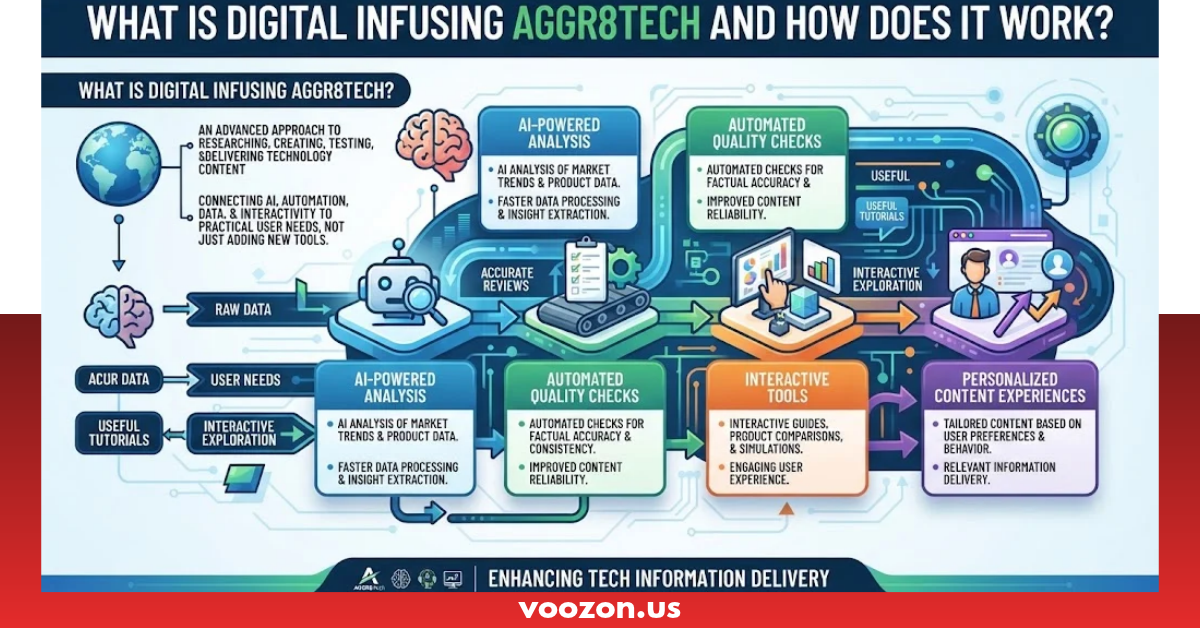
Digital infusing aggr8tech describes an approach to using digital technology as part of the actual process of researching, creating, testing, and delivering technology information. Instead of adding tools simply because they are new, the approach connects AI analysis, automation, interactive experiences, data, and personalization to practical user needs.
AGGR8 Tech describes its own approach as using technology to make reviews more accurate, tutorials more useful, and technical information easier to explore. Its published material specifically discusses AI-powered analysis, interactive tools, automated quality checks, and personalized content experiences.
Digital infusing aggr8tech means integrating digital tools into technology research and content workflows so users can get more useful, current, interactive, and practical information.
It is better understood as a working methodology than as the name of one specific software product or standardized technology.
Why Is Digital Infusing Aggr8tech Important?
Technology information changes quickly. Product specifications can change, software receives updates, development tools evolve, and users expect answers that are useful rather than generic.
A digital-first workflow can help reduce some of the friction involved in keeping technical content current. AGGR8 Tech says it uses automation for tasks such as checking links, identifying changing specifications, and validating technical examples.
The real value comes from connecting these technologies to a clear purpose:
- Research information faster
- Compare larger amounts of data
- Keep technical information updated
- Make tutorials interactive
- Improve product comparisons
- Reduce repetitive quality checks
- Personalize content discovery
- Help readers understand technology through practical examples
This makes digital infusing aggr8tech less about collecting tools and more about creating a useful system around them.
How Does Digital Infusing Aggr8tech Work?
The approach can be broken into several connected stages.
First, technology collects and organizes information. AI and data-analysis systems can help identify patterns across large datasets.
Next, human judgment checks the information. Technical claims still need verification because data alone does not explain whether a result makes sense in a real situation.
The information can then become an interactive experience. A reader might test code, examine a 3D model, compare specifications, or explore related information without leaving the page.
Finally, automation and personalization can help maintain and organize the experience.
The Basic Workflow
| Stage | Technology Used | Main Purpose | User Benefit |
| Research | AI, databases, technical documents | Collect information | Faster discovery |
| Analysis | Machine learning, data analysis | Identify patterns | Better comparisons |
| Verification | Human testing and review | Check accuracy | Greater trust |
| Presentation | Interactive tools, visuals | Explain concepts | Easier learning |
| Automation | Scripts and monitoring | Handle repetitive checks | Fresher information |
| Personalization | Recommendation systems | Organize relevant content | Better discovery |
| Improvement | Analytics and feedback | Find weak areas | Better future content |
The important point is that each technology has a job. A tool becomes useful when it solves a real problem rather than simply appearing impressive.
How Does AI Support Digital Infusing Aggr8tech?
AI can process information at a scale that would be difficult to handle manually. In technology research, that can include comparing performance information, identifying patterns, analyzing user feedback, or organizing technical documents.
AGGR8 Tech says its AI systems help identify patterns in product data, while its human-led process verifies claims and adds real-world context.
That distinction matters.
AI can help answer questions such as:
- What patterns appear across many test results?
- Which features receive repeated user complaints?
- Which technologies are gaining attention?
- How do different configurations affect performance?
- Which information needs another verification step?
Human review remains important because an algorithm can identify a pattern without understanding its practical meaning.
AI and Human Expertise Work Together
A useful technology workflow can divide responsibilities:
AI handles:
- Large-scale data processing
- Pattern detection
- Initial information gathering
- Classification
- Repetitive analysis
People handle:
- Testing
- Context
- Fact verification
- Practical judgment
- Editorial decisions
- Explaining difficult concepts
This combination gives digital infusing aggr8tech a practical foundation instead of treating AI as a replacement for expertise.
What Role Does Interactive Content Play?
Reading about technology is useful, but interacting with it can make difficult concepts easier to understand.
AGGR8 Tech describes using live code editors, interactive 3D models, and augmented-reality experiences in suitable content. These features allow readers to test or explore information instead of only reading static explanations.
For example, a programming tutorial could include a browser-based editor. Instead of copying code into another application, the reader can change the example directly and observe the result.
A gadget article could use a 3D model so readers can examine ports, buttons, dimensions, or physical design.
Interactive Features Can Include
- Live code examples
- Product comparison tools
- 3D product models
- Interactive charts
- Specification filters
- Demonstration tools
- AR product previews
- Calculators
- Visual explainers
The feature should always support the reader. An interactive element that adds confusion or slows down a page without providing useful information has little practical value.
How Does Automation Improve Technology Content?
Technology websites often manage hundreds or thousands of individual details. Links can break, software changes, specifications get updated, and old examples can stop working.
Manual checking of every item can consume valuable time.
Automation can monitor repetitive tasks and flag problems for human review. AGGR8 Tech says its scripts can check broken links, monitor specification changes, and validate code examples.
Examples of Useful Automation
| Automated Task | What It Can Detect | Human Follow-Up |
| Link checking | Broken URLs | Replace or remove links |
| Specification monitoring | Changed product data | Verify with manufacturer |
| Code checking | Syntax problems | Test and update example |
| Content monitoring | Outdated information | Review article |
| Data collection | New information | Validate sources |
| Performance checks | Technical issues | Investigate cause |
The goal is not to automate every editorial decision.
Instead, automation should handle repetitive work so people can spend more time on testing, analysis, and explanation.
Can Digital Infusing Aggr8tech Improve Personalization?
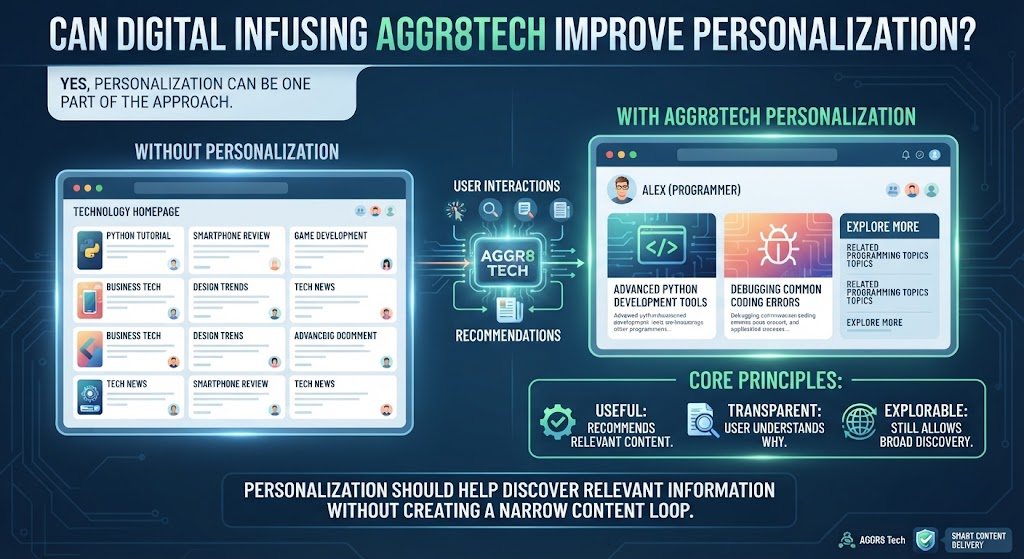
Yes, personalization can be one part of the approach.
A technology website may contain content for programmers, gamers, smartphone users, business owners, designers, and general readers. Showing everyone the exact same information can make discovery harder.
A recommendation system can use a reader’s interactions with content to suggest related topics.
For example, someone reading several Python tutorials might receive recommendations for development tools, debugging guides, or related programming topics.
However, personalization should remain useful and transparent. Readers should still be able to explore topics outside their usual interests.
A good recommendation system helps users discover relevant information without turning the entire experience into a narrow content loop.
What Technologies Are Connected to Digital Infusing Aggr8tech?
The concept can include several technology categories rather than one specific platform.
1. Artificial Intelligence
AI can support research, classification, pattern recognition, and information processing.
2. Machine Learning
Machine-learning models can identify patterns across large datasets and help create more informed comparisons.
3. Automation
Automated systems can monitor repetitive tasks such as links, data changes, and technical checks.
4. Interactive Web Technology
Interactive components can allow readers to experiment with code, compare products, or explore technical information.
5. Data Analytics
Analytics can reveal how users interact with content and which information performs useful functions.
6. Cloud Technology
Cloud platforms can provide scalable infrastructure for applications, databases, analytics, and online services.
7. 3D and AR Technology
Three-dimensional models and augmented reality can help users understand physical products and environments.
8. Recommendation Systems
Personalization technology can organize content according to user interests and behavior.
These technologies become more valuable when they work together around a specific user problem.
Digital Infusing Aggr8tech vs Traditional Tech Content
Traditional technology content often follows a simple structure: research a subject, write an article, add images, publish it, and update it later.
A digitally integrated approach can add more layers.
| Traditional Approach | Digitally Infused Approach |
| Static article | Interactive experience |
| Limited data | Larger datasets |
| Manual checking | Automated monitoring |
| One-size-fits-all content | Personalized recommendations |
| Static product images | 3D or AR experiences |
| Basic research | AI-assisted research |
| Occasional updates | Continuous monitoring |
| Reader consumes information | Reader can interact with information |
Neither approach needs to be used exclusively. A simple article can still be the right format when a reader only needs a clear answer.
The technology should match the purpose.
What Are the Main Benefits?
The strongest benefits come from combining technology with a clear editorial process.
Better Information Discovery
AI and data tools can help researchers process large amounts of information and identify useful patterns.
Faster Updates
Automation can identify information that may need review, helping publishers respond to changes more quickly.
Stronger User Engagement
Interactive features can turn passive reading into active exploration.
More Useful Comparisons
Large datasets can provide broader context than a single test or isolated observation.
Easier Technical Learning
Live examples and interactive demonstrations can make difficult subjects easier to understand.
More Relevant Recommendations
Personalization can help readers find related information without manually searching through an entire website.
Better Workflow Efficiency
Automating repetitive tasks can free researchers and writers to focus on work that requires human judgment.
What Are the Limitations and Risks?
Technology does not automatically create accurate or trustworthy information.
AI systems can produce incorrect information. Automated processes can also repeat an error at scale if nobody checks the output.
Privacy is another consideration when personalization systems collect behavioral information. Websites should clearly explain how user data is handled and avoid collecting information that is not necessary for the service.
Interactive features also require maintenance. A code editor, API, 3D model, or embedded tool can stop working when its underlying technology changes.
Key Risks to Watch
- Incorrect AI-generated information
- Outdated datasets
- Poor source verification
- Privacy problems
- Broken interactive features
- Over-automation
- Excessive personalization
- Slow page performance
- Unclear ownership of data
- Lack of human review
A strong system therefore needs testing, monitoring, source verification, and clear editorial responsibility.
How Can Businesses Use Digital Infusing Aggr8tech?
Businesses can apply the concept beyond publishing.
An online retailer could combine product databases, recommendation technology, analytics, and interactive product demonstrations.
A software company could provide interactive documentation, live code examples, automated testing, and personalized learning paths.
A technology publisher could combine AI-assisted research with human testing, automated content monitoring, interactive comparisons, and recommendation systems.
Practical Business Applications
| Business Area | Possible Application |
| E-commerce | Product recommendations and 3D previews |
| Software | Interactive documentation |
| Publishing | AI-assisted research and automated checks |
| Education | Interactive lessons and simulations |
| Marketing | Personalized content journeys |
| Customer Support | Automated knowledge systems |
| Product Development | Data analysis and user feedback |
| Gaming | Interactive demonstrations and analytics |
The strongest implementation begins with a business problem.
For example, if customers cannot understand a product’s physical dimensions, a 3D model may help more than another 1,000-word description.
How Can Content Creators Apply the Approach?
Content creators do not need an expensive technology stack to use these ideas.
Start with the reader’s biggest problem.
If readers struggle to compare products, create a comparison table or interactive filter. If they struggle with code, add a working example. If information becomes outdated quickly, establish a review and update process.
A Simple Implementation Plan
Step 1: Identify the problem.
Find the part of the reader journey that creates the most friction.
Step 2: Choose one suitable tool.
Do not add technology simply for appearance.
Step 3: Build the experience.
Connect the tool directly to the information users need.
Step 4: Verify everything.
Check data, claims, links, code, and interactive elements.
Step 5: Monitor performance.
Look at feedback, engagement, errors, and content freshness.
Step 6: Improve gradually.
Keep useful features and remove anything that does not help readers.
This approach keeps digital infusing aggr8tech practical rather than turning it into a collection of disconnected technologies.
How Does It Support SEO, AEO, IEO, and GEO?
Search optimization still starts with useful information.
Google’s current documentation says its generative AI search guidance continues to emphasize established SEO fundamentals and original, non-commodity content. Google also says its AI search features follow the same general Search policies and systems rather than requiring a completely separate form of SEO.
That means a technology-focused page should prioritize:
- Clear answers
- Original information
- Helpful structure
- Accurate facts
- First-hand experience where applicable
- Strong source selection
- Descriptive headings
- Useful tables
- Direct question-and-answer sections
- Easy navigation
- Updated information
For AEO and AI search visibility, clearly answering questions can help machines and people understand the page.
For IEO, entities and relationships should be explained naturally. A page can mention relevant concepts such as artificial intelligence, machine learning, automation, data analytics, augmented reality, and interactive web technology when they genuinely support the topic.
For GEO, the same principle applies: create information that is specific, useful, original, and easy for both users and search systems to understand.
What Makes a Trustworthy Aggr8tech Resource?
Trust comes from evidence and transparency.
AGGR8 Tech’s own article explains its technology workflow through examples of AI analysis, automation, interactive tools, and personalization. Its broader technology content also describes research and testing as part of its editorial approach.
A trustworthy article about this topic should clearly distinguish:
- What the source actually states.
- What can be independently verified.
- What represents an interpretation.
- What remains a developing idea.
This is especially important because the phrase digital infusing aggr8tech appears online in several different contexts. The first-party AGGR8 Tech material provides the most useful basis for explaining what the phrase means in relation to that website.
Recommended Trust Signals
- Named author
- Author expertise
- Publication date
- Updated date when applicable
- Primary sources
- Clear methodology
- First-hand testing
- Transparent limitations
- Accurate citations
- Contact or editorial information
These signals help readers understand why they should trust the information they are reading.
What Is the Future of Digital Infusing Aggr8tech?
The underlying idea is likely to become more practical as technology becomes easier to connect.
AI can handle larger research workloads. Automation can monitor more information. Interactive web technology can make technical explanations more useful. Personalization can improve content discovery.
The important shift is not simply adding more technology.
It is connecting the right technology to the right problem.
That could mean an interactive product comparison instead of a long specification list, an automated update system instead of repeated manual checks, or an AI-assisted research workflow followed by careful human verification.
The future of digital infusing aggr8tech therefore depends less on how many tools a publisher uses and more on whether those tools create measurable value for readers.
Digital Infusing Aggr8tech: Key Takeaways
Here are the main points to remember:
- Digital infusing aggr8tech is best understood as a technology-integrated approach rather than one standalone software product.
- AI can assist with research and large-scale data analysis.
- Human testing remains important for verification and context.
- Interactive tools can make technical content easier to understand.
- Automation can handle repetitive monitoring and quality tasks.
- Personalization can help readers discover relevant content.
- Data analytics can reveal how users interact with information.
- Privacy and accuracy need active attention.
- Technology should solve a real user problem rather than exist for decoration.
- Helpful, original, trustworthy information remains central to search visibility.
Frequently Asked Questions
What does digital infusing aggr8tech mean?
Digital infusing aggr8tech refers to integrating digital technologies into technology research, content creation, analysis, automation, and user experiences. The AGGR8 Tech explanation connects the concept with AI analysis, interactive content, automation, and personalization.
Is digital infusing aggr8tech a software product?
No. Based on the first-party material available from AGGR8 Tech, the phrase describes an approach to using technology rather than clearly identifying one standalone software product. The concept covers multiple tools and workflows.
How does AI fit into digital infusing aggr8tech?
AI can process large amounts of information, identify patterns, assist with research, and support data analysis. Human review remains necessary to verify important claims and provide real-world context.
Can small businesses use digital infusing aggr8tech?
Yes. A small business does not need a complex technology stack. It can start with one practical improvement, such as automated monitoring, personalized recommendations, interactive product information, or better data analysis.
Does digital infusing aggr8tech help with SEO?
It can support the creation of useful, structured, original content, but no technology guarantees search rankings. Google continues to emphasize helpful, reliable, people-first content and has stated that its AI search experiences build on established Search fundamentals.
What should I focus on first?
Start with the user’s problem. Choose technology that makes the answer clearer, faster, more accurate, easier to test, or easier to understand. Then measure whether the improvement actually helps.
Conclusion:
Digital infusing aggr8tech is ultimately about making technology useful rather than simply making content look technical. AI can process information, automation can manage repetitive checks, interactive tools can improve learning, and personalization can make discovery easier.
The human role remains essential. People still need to test products, verify claims, interpret data, protect user privacy, and explain complex subjects clearly.